
Mahosadha Jataka
The Mahosadha Jataka: The Wise Minister Mahosadha
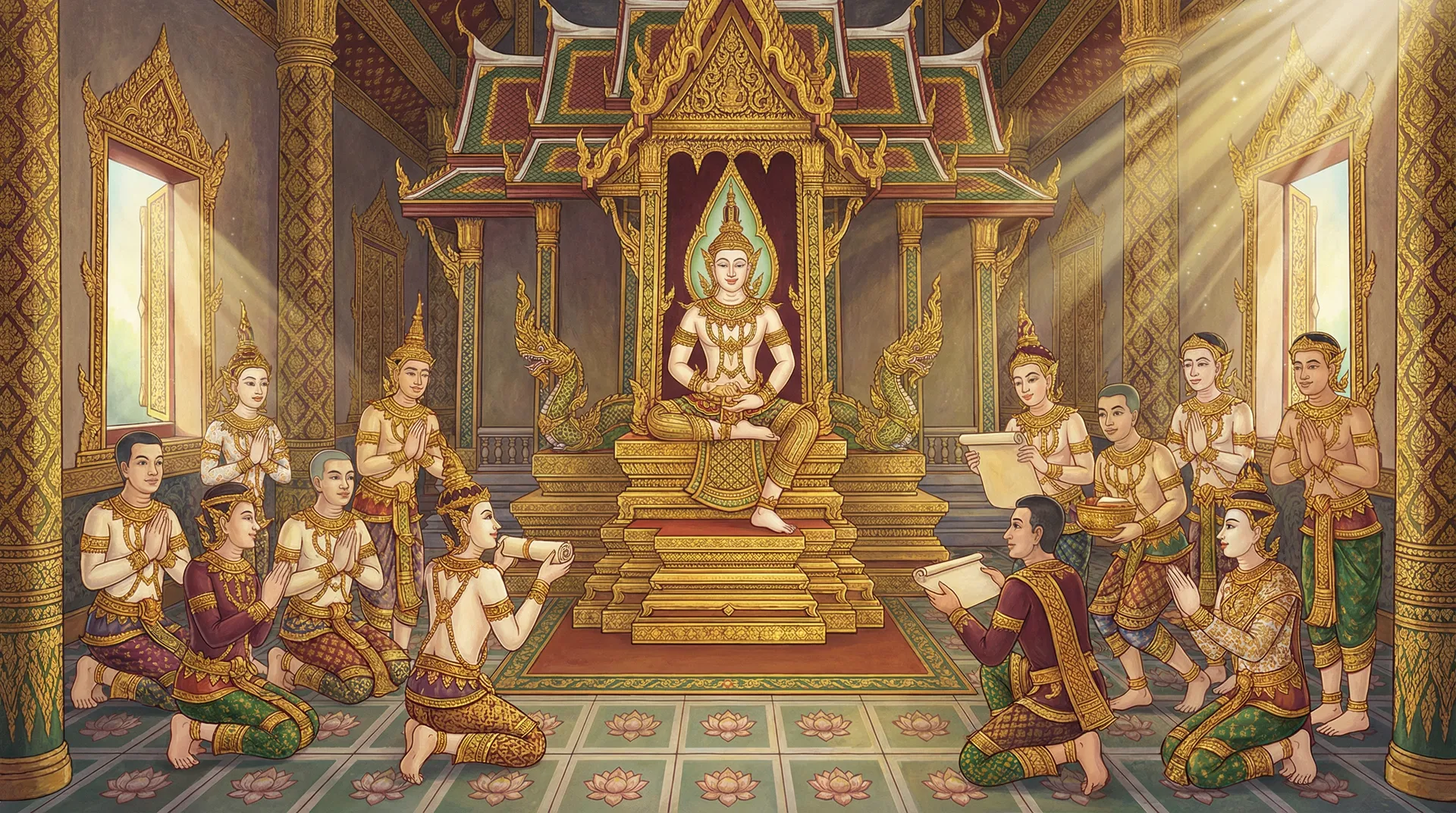
In the ancient kingdom of Videha, ruled by the just King Vedeha, there served a minister of unparalleled intellect and wisdom named Mahosadha. Mahosadha was not just a minister; he was the Bodhisatta, who in this life, was perfecting the virtue of wisdom through his astute judgments and foresight.
The kingdom of Videha was often embroiled in disputes, both within its borders and with neighboring kingdoms. It was in these times of trouble that Mahosadha's brilliance shone brightest. His mind was like a finely honed instrument, capable of dissecting complex problems and finding solutions that were both practical and ethical.
One day, a dispute arose between two wealthy merchants, both claiming ownership of a priceless jewel. The jewel was magnificent, with facets that sparkled like captured stars, and it was said to possess a magical radiance. Both merchants presented their cases with fervor, each convinced of his rightful claim. The court was divided, and the king himself was perplexed.
"Mahosadha," King Vedeha declared, his voice heavy with the weight of the dispute, "you are known for your keen intellect. How shall we resolve this matter?"
Mahosadha, with his characteristic calm demeanor, requested that the jewel be brought before him. When it arrived, he did not examine it closely or question the merchants further. Instead, he instructed his servants to place the jewel in a bowl of water.
The merchants watched with bated breath. As the jewel sank, the water remained perfectly clear. Mahosadha then asked for a different jewel, one that was known to be of lesser quality, perhaps with a hidden flaw or made with a less precious metal. This second jewel was also placed in water, and this time, the water immediately became cloudy, particles of dust and impurities clouding its clarity.
Mahosadha then turned to the merchants. "The true jewel," he explained, "is like pure water; it does not cloud or contaminate. The jewel presented by the first merchant did not release any impurities into the water, indicating its purity and inherent worth. The jewel presented by the second merchant, however, clouded the water, revealing it to be of lesser quality, perhaps even a clever imitation. Therefore, the jewel belongs to the merchant who presented the purer substance."
The court was astounded by this simple yet ingenious solution. The merchants, accepting the verdict, bowed to Mahosadha's wisdom. This was just one of countless instances where Mahosadha's sharp mind brought justice and order to the kingdom.
Another time, a neighboring kingdom, jealous of Videha's prosperity, sought to provoke a war. Their king sent a delegation with a seemingly impossible riddle: "Tell us," they demanded, "how many drops of water are there in the great ocean?" If the king of Videha could not answer, they would declare war.
King Vedeha was in despair. His own scholars were baffled. He turned to Mahosadha, his face etched with worry. "Mahosadha, our kingdom's fate rests on your wisdom. How can we answer such a foolish question?"
Mahosadha smiled confidently. "Your Majesty, do not worry. I shall handle this." He instructed the king to send a message back to the neighboring kingdom: "We will answer your riddle, but only after your delegation has counted every single grain of sand on our shores."
The neighboring king, upon receiving this reply, was furious. He realized he had been outwitted. His own demand was equally impossible to fulfill. Embarrassed and outmaneuvered, he withdrew his delegation and abandoned his plans for war.
Mahosadha's wisdom was not limited to legal disputes or diplomatic challenges. He was also a visionary leader, always thinking ahead. When the kingdom faced a severe drought, while others panicked, Mahosadha organized the construction of a vast network of underground canals and reservoirs, ensuring that water was stored and distributed efficiently. He also implemented innovative farming techniques that allowed crops to grow even in arid conditions.
He once devised a clever plan to expose a corrupt official who was hoarding grain during a time of scarcity. Mahosadha subtly spread a rumor that the king was giving away a rare, magical herb that could cure any illness. The corrupt official, greedy for power and influence, rushed to get his hands on this supposed cure, inadvertently revealing his hidden stores of grain in his haste. Mahosadha's plan not only exposed the corruption but also ensured that the hoarded grain was distributed to the people.
Mahosadha's life was a testament to the power of a well-trained mind. He taught the king and his people that true strength lies not in brute force or political maneuvering, but in clear thinking, foresight, and a deep understanding of cause and effect. His judgments were always fair, his advice always sound, and his foresight always protected the kingdom from disaster.
Through his wisdom, Mahosadha ensured that the kingdom of Videha flourished, becoming a beacon of justice, prosperity, and peace. He demonstrated that even the most complex problems can be solved with intelligence, logic, and a compassionate understanding of human nature. His legacy was not one of conquests or decrees, but of the enduring power of a wise mind guiding its people towards a better future.
— In-Article Ad —
💡Moral of the Story
Wisdom, clarity of thought, and foresight are the most powerful tools for solving problems, dispensing justice, and ensuring the prosperity and peace of a kingdom. True leadership lies in intelligent and ethical decision-making.
Perfection: Wisdom (Panna)
— Ad Space (728x90) —
More Jataka Tales You May Enjoy
 165Dukanipāta
Mahasattva Jataka
The Bodhisatta's Compassion for the Hungry TigressIn the vast, untamed wilderness of the Himalayas, ...
💡 The highest form of compassion is selfless sacrifice, willing to give one's own life for the well-being of others, even for animals, to alleviate suffering and demonstrate ultimate love.
163DukanipātaMaha-Ummagga Jataka
The Great Wisdom of Prince Vessantara (The King of Wisdom)In the magnificent city of Jetuttara, rule...
💡 True generosity lies in selfless giving, not for recognition or reward, but for the alleviation of suffering and the pursuit of peace. Wisdom is found in understanding the impermanence of possessions and transcending attachment.
 517Vīsatinipāta
Mahāsuvanna Jataka
The Golden Swan's FlightIn the ancient city of Mithila, nestled beside a shimmering lake, lived a ki...
💡 True power and prosperity are not achieved through aggression or conquest, but through wisdom, righteousness, and compassion. Upholding ethical principles is the foundation of a just and harmonious society.
154DukanipātaMātanga Jātaka
Mātanga JātakaIn the ancient city of Mithila, there lived a young woman of unparalleled beauty and g...
💡 True wisdom is accompanied by humility and compassion; superficial knowledge, when fueled by ego, leads to arrogance.
199DukanipātaSankha Jātaka
The Tale of the Generous Prince SankhaIn the ancient kingdom of Indapatta, ruled a just and benevole...
💡 True wealth is found not in hoarding possessions, but in selfless giving. Generosity, when offered with a pure heart, can overcome scarcity and inspire a spirit of community and mutual support.
151DukanipātaMūtapāda Jātaka
Mūtapāda JātakaIn the ancient kingdom of Kosala, nestled beside the winding Sarayu River, stood the ...
💡 True understanding and compassion can transform an unfortunate incident into a lesson of dedication and loyalty. Even the smallest creatures deserve kindness and respect.
— Multiplex Ad —